Diesel Shipments: Tankers Head for US Coasts Amid Legal Debate
Three vessels carrying Russian fuel are en route to American ports while a fourth prepares to leave, triggering a clash between the White House and Congress over the legality of the imports.
By Rafael Esposito ·
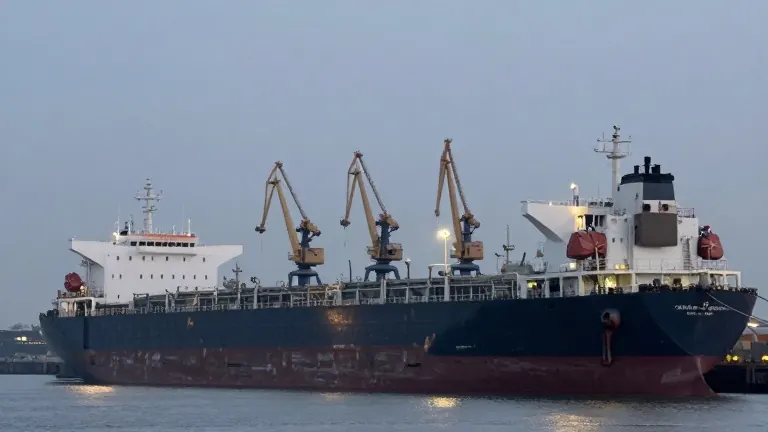
Three tankers loaded with Russian diesel are currently crossing the Atlantic toward American ports. A fourth vessel is scheduled to depart Russia on October 28. This cargo represents the first authorized shipments under a deal struck between President Donald Trump and Russian President Vladimir Putin on October 9. The agreement temporarily permits these imports to help lower domestic diesel prices. Rising costs were driven by supply disruptions from the war in Iran and Ukrainian attacks on Russian refineries.
The deal has sparked a legal dispute over whether the executive branch can bypass a 2022 law. That statute, the Ending Importation of Russian Oil Act of 2022, bans the importation of Russian energy products. Senator Richard Blumenthal, D-Conn., argues that the administration lacks the authority to waive this ban without congressional approval. He sent letters to two shipping companies on Tuesday. He demanded that they recall their tankers and provide details on federal guidance by October 31. Blumenthal stated that the Treasury Department's General License No. 135 cannot override the existing import ban.
Jeremy Paner, a partner at Hughes Hubbard & Reed, disagrees with that interpretation. He confirmed to Fox News Digital that the president has the legal authority to authorize these specific imports. Paner explained that a license does not remove the underlying prohibition; it simply allows the transaction to proceed. "A license does not get rid of a prohibition. It's simply allowed," he said. The Treasury Department's Office of Foreign Assets Control issued the authorization covering these shipments.
The incoming vessels face additional scrutiny due to their sanction status. The Agioi Fanendes, flagged in Malta, is carrying about 40,000 metric tons of diesel. It is signaling New York as its destination, with an estimated arrival of November 7. A second vessel, the Talisman, is 20 years old and is sanctioned by the U.S., United Kingdom, and the European Union. It is expected to reach the East Coast on November 9. The third tanker, the Leruo, is flagged in Sierra Leone and owned by a Hong Kong company. It is signaling an East Coast arrival around November 11.
The Leruo was sanctioned in 2025 by the EU, UK, and Canada over alleged deceptive shipping practices. Paner noted that the U.S. authorization allows these shipments to proceed under American rules, even if a vessel is designated under U.S. sanctions. However, he warned that foreign companies may still face issues under EU, UK, or Canadian sanctions. "There could be European operators involved, and the U.S. authorization would not authorize those European, U.K. or Canadian companies to have any involvement in these shipments," Paner said. This complexity may explain why sanctioned vessels are being used for the deliveries.
Under the October 9 deal, Washington authorized these imports in exchange for Moscow releasing 300,000 metric tons of diesel to global markets. This amount will rise to 500,000 tons in November and potentially 1 million tons per month thereafter. Russian Deputy Prime Minister Alexander Novak confirmed the tanker movements on Tuesday. He said the fourth ship had not yet departed. Novak criticized Democrats for opposing the arrangement, stating their stance was not in the best interests of U.S. residents.
Lawmakers in Congress are preparing for potential investigations. In an October letter to commercial banks, fuel distributors, and port authorities in New York, New Jersey, and along the Texas Gulf Coast, they warned that companies involved in the diesel shipments could face scrutiny. The letter demanded that these entities preserve transaction records, port reservations, and communications. Recipients were given until October 28 to confirm they had taken steps to retain the documents. Paner predicted that Congress would investigate U.S. involvement first, which would help identify the non-U.S. companies involved in the logistics.
Source: Fox News
More Business · Rip-Off Report · Report a business · Got a Story?