Sorbonne Model Identifies Rare Freezing Physics Behind Mars Cloud
A new simulation reproduces the 1,000-mile Arsia Mons cloud using a process requiring humidity levels 100,000 times higher than Earth's maximum.
By Rafael Esposito ·
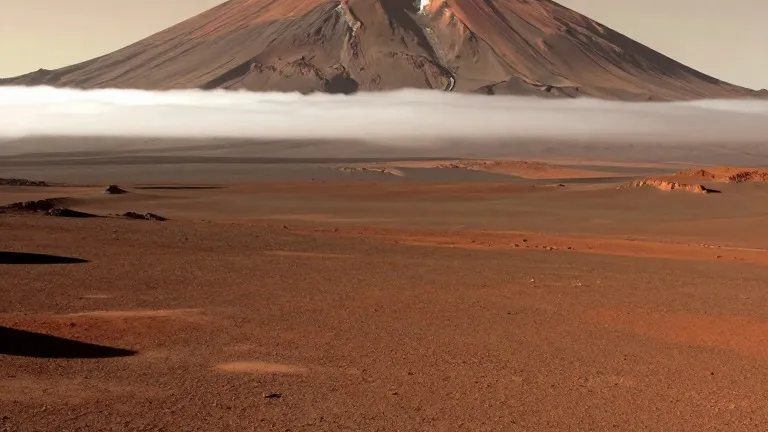
Scientists have long puzzled over a massive cloud that stretches across the Martian landscape every morning. A new study published in Nature Geoscience offers a concrete explanation for the phenomenon known as the Arsia Mons Elongated Cloud.
The feature appears during Martian spring and summer, growing to a length comparable to the straight-line distance between New York and Kansas City. It vanishes by late morning, a cycle that has repeated for months since a probe first recorded it in 2018. Previous attempts to model the cloud failed until researchers incorporated a specific physical process.
Jorge Hernández-Bernal, a planetary scientist at Sorbonne Université in Paris, led the team that successfully reproduced the cloud in simulations. He described the required mechanism as exotic physics that appears in textbooks but is rarely considered real in nature. Once the model included this process, the cloud formed exactly as observed in satellite data.
The study proposes the cloud forms through homogeneous nucleation. On Earth, water vapor condenses around dust or salt particles. On Mars, the vapor turns directly into ice crystals without any debris to seed the reaction. Hernández-Bernal compared the process to condensation appearing in the middle of a room rather than on a window.
Creating these conditions requires extreme environmental factors. The model shows the temperature must drop 30 degrees Celsius within 10 minutes. The 65,000-foot Arsia Mons volcano plays a central role by generating wind waves that lift moist air into the atmosphere rapidly.
The humidity required for this reaction exceeds any value measured on Earth by more than 100,000 times. This extreme level was previously unknown on Mars, suggesting the planet's atmosphere holds conditions that defy standard planetary expectations. The findings challenge the assumption that such nucleation only occurs in the upper atmospheres of worlds like Venus.
The team noted that limited data on the Martian atmosphere makes the precise reproduction of the cloud a major scientific milestone. Hernández-Bernal called the result remarkable, emphasizing that the model now accounts for the cloud's specific timing and scale.
Source: Wired