Early Universe Light Caps Dark Matter Black Holes at 100 Billion Suns
New analysis of cosmic background radiation indicates that supermassive black holes weighing more than 100 billion solar masses cannot constitute a major portion of the universe's invisible mass.
By Jisoo Serrano ·
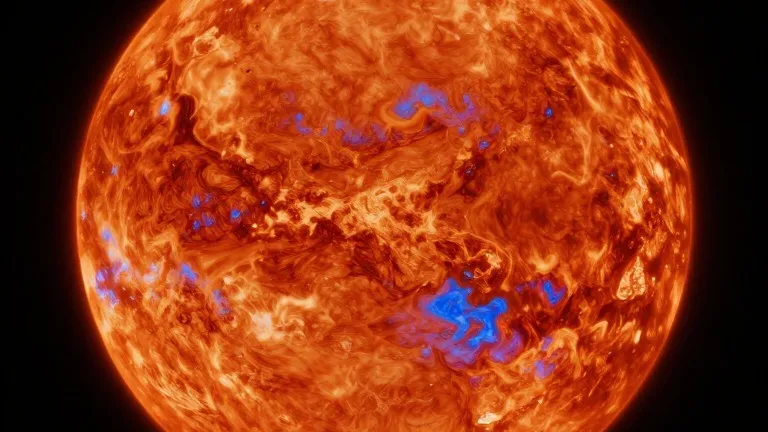
Researchers determined that black holes weighing more than 100 billion times the mass of the sun cannot account for a large share of dark matter. The finding narrows the search for the substance that holds galaxies together and comprises about five-sixths of all matter in the cosmos. This result eliminates a specific class of extremely massive objects as a primary component of the universe's hidden mass.
The study examined "stupendously large black holes," which would weigh between 1 million and 10 million billion solar masses. Objects of this scale would outweigh entire galaxies. No such black holes have been detected yet, and the largest known weighs approximately 36 billion suns. Because surveys of many galaxies have not found these massive objects, scientists suspected they might be a fraction of dark matter rather than the whole. The new analysis tested that hypothesis directly.
Christopher Gerlach, a theoretical physicist at the Mainz Institute for Theoretical Physics in Germany, noted that dark matter is typically viewed as a fine dust spread throughout space. He explained that if dark matter were concentrated in a few gigantic objects, the universe would appear grainy on very large scales. The team checked for this graininess using the cosmic microwave background, the light released from the early universe. This radiation has been traveling since the first 380,000 years after the Big Bang, when the universe cooled enough for light to travel freely.
Antonio Iovino, a theoretical physicist at New York University Abu Dhabi, described the background's temperature variations as about one part in 100,000. These small differences reveal how matter was distributed in the infant universe. The analysis showed that the background lacks the graininess that would result from the presence of stupendously large black holes. Nicholas Leister, also at the Mainz Institute for Theoretical Physics, stated that this means these black holes cannot be a significant part of dark matter.
The authors clarified that the result does not prove such enormous black holes cannot exist. It only indicates they are not a major component of the universe's mass. The team is now examining whether relatively tiny black holes, about the size of asteroids, can be ruled out as a major constituent. The findings are scheduled for publication in the journal Physical Review Letters on Oct. 26.
Source: Space.com